Skip to content

Industrial Design

design_services
design_services

Industrial Design

Design Registration & Protection

1

Overview

The Bangladesh Industrial Design Act, 2023, serves as the regulatory framework for industrial design registration within the country. Industrial design is defined as the professional practice involved in designing physical products intended for mass production.
Industrial Design Process
zoom_in

Nature and Significance

Industrial design is a discipline centered on developing products, environments, and systems that are functional, user-centric, and aesthetically pleasing. Professionals in this field utilize their expertise in materials, engineering, aesthetics, and ergonomics to craft items that are visually attractive while meeting the requirements of potential users. This practice is significant for several reasons: • User Efficiency: It facilitates the creation of products that are more efficient and user-friendly by considering user preferences. • Market Differentiation: It assists companies in distinguishing their offerings from competitors by developing products that are visually distinctive. • Sustainability: Designers can impact sustainability by creating products that are environmentally friendly and durable. • Societal Impact: By developing products that improve daily life, industrial designers contribute to societal betterment.

2

Distinctions from Other Design Disciplines

While interior design, graphic design, and industrial design share principles like functionality and aesthetics, they differ in techniques, skills, and focus. • Industrial Design: This field concerns the design of physical systems and products, such as industrial equipment, vehicles, and consumer goods. Designers collaborate with manufacturers and engineers to ensure products are cost-effective, functional, and aesthetic. • Graphic Design: This area focuses on visually communicating ideas and information. Designers utilize images, color, and typography to create visual content like packaging, logos, and advertisements. • Interior Design: This involves designing interior spaces like commercial buildings, offices, and homes. Designers work with clients and architects to create spaces that reflect client needs and are functional.
3

Core Principles

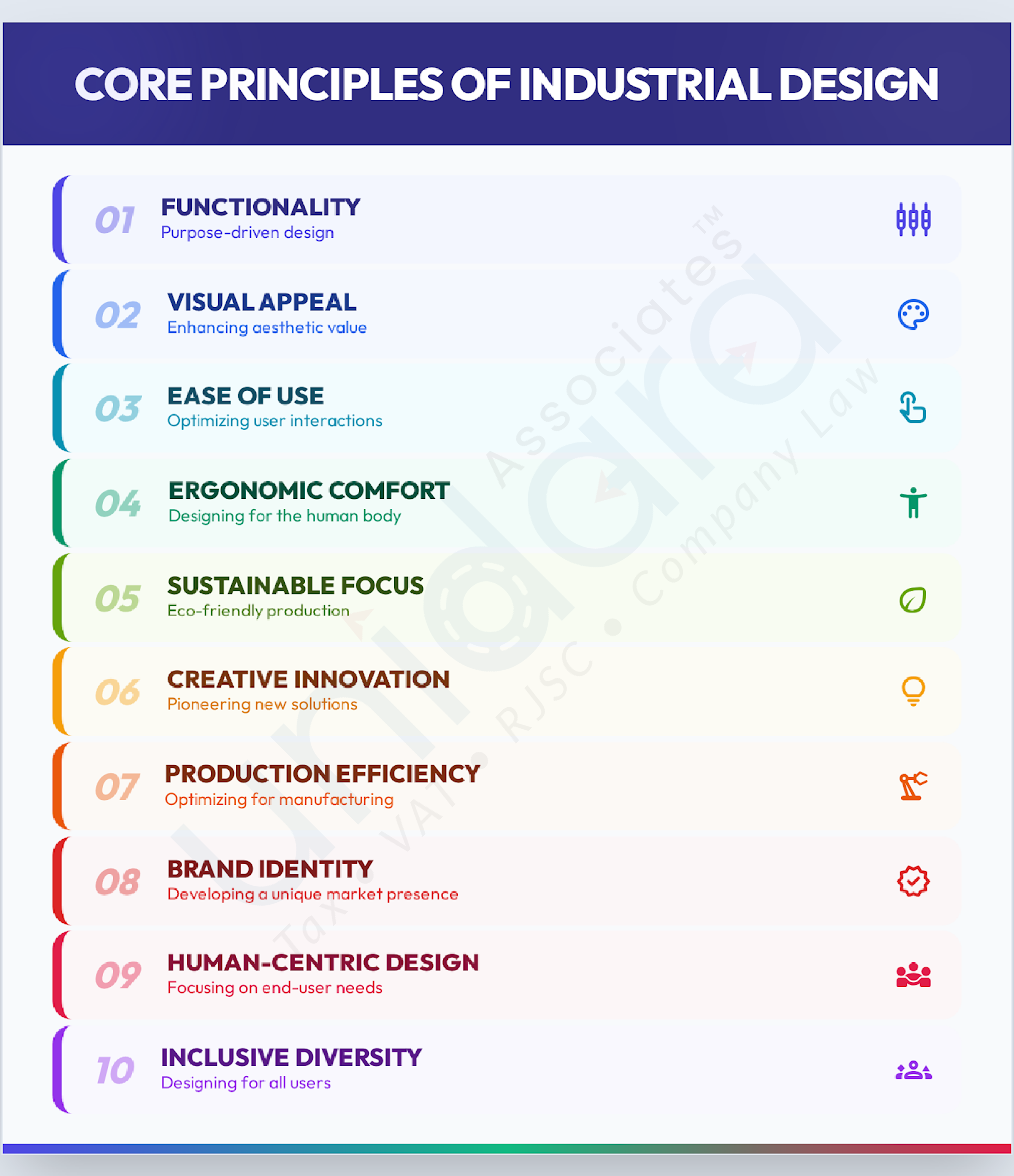
Industrial designers utilize a set of guidelines to create user-centered and effective products. Common principles include: • Functionality: The design must perform its intended task efficiently and meet user requirements. • Aesthetics: The product should be visually attractive regarding texture, form, and color. • Usability: Items should be easy to understand and use, offering clear feedback and intuitive controls. • Ergonomics: Designs must be safe and comfortable, accounting for the user's physical capabilities and dimensions. • Sustainability: The process should be environmentally responsible regarding energy use, material selection, and disposal. • Innovation: The integration of new materials, technologies, and ideas is essential. • Manufacturability: Designs must be feasible and cost-effective for large-scale production. • Branding: The product should reflect the values and brand identity of the company. • User-Centered Design: Decisions should be based on a deep comprehension of user behavior and needs. • Design for Diversity: The design must consider the varied abilities and needs of different users, including those with special needs.
4

Essential Tools and Technologies

Designers employ various technologies and tools throughout the creation process, including: • Sketching Tools: The process often begins with paper sketches using markers, pens, or pencils. • Computer-Aided Design (CAD): Software allows for the creation of 3D models to test and refine ideas. • Prototyping Tools: Physical prototypes are created using laser cutters, CNC machines, and 3D printers. • Rendering Software: Used to generate photorealistic animations and images for presentations. • AR/VR Tools: Augmented and virtual reality create immersive simulations for testing designs before production. • Material Databases: Knowledge of materials like fabrics, metals, and plastics is supported by libraries helping in material selection. • Ergonomics Tools: Techniques to analyze usability, such as user testing and anthropometric data. • Collaboration Tools: Software for project management and communication with stakeholders and suppliers.
5

The Role of User-Centered Design

Adopting a user-centered approach ensures designs meet the demands of the intended audience while remaining visually appealing. This involves: • Research: Gathering information on user needs through observation, data analysis, and surveys to tailor designs. • Prototyping: Creating mockups to test with users and receiving feedback for adjustments. • Testing: Verifying the final product is easy to use and meets user needs through usability testing. This approach leads to a better brand reputation, increased sales, and higher customer satisfaction.
6

Intellectual Property Rights and Industrial Design

Intellectual property rights are crucial for protecting designs and ensuring creators receive compensation. • Patents: These grant exclusive rights to sell, use, and make an invention for a specific period, usually 20 years. They apply to machines, products, and processes. • Trademarks: These include designs, symbols, or words distinguishing one company's products from another, protecting brand identity. • Other Protections: Copyrights protect original artistic works, design patents cover ornamental designs, and trade secrets protect confidential information like manufacturing processes.
7

Filing Requirements for Design Registration in Bangladesh

1. Applicant Details: Name and address of the candidate. 2. Representation: Submission of four identical representations of the article on the specified form, clearly showing design elements from various angles (photos, drawings, or samples). 3. Declaration of Novelty: A succinct description of the novelty seeking protection must accompany the application or be submitted before registration. 4. Disclaimers: An endorsement stating no claim is made to the ownership of trademarks, numbers, words, letters, or mechanisms. 5. Product Classification: Goods are categorized into fourteen classes for registration purposes. 6. Power of Attorney (POA): The original POA must be submitted within one month of filing. 7. Priority: To claim priority from an earlier application in a convention country, a written declaration must be appended within six months of the earlier date. Non-English priority documents must be notarized or verified in English.
8

Registration Criteria & Design Categories

Criteria for Design Registration: • Declaration of the applicant type (company or individual). • A statement of novelty proving the uniqueness of the design. • Power of Attorney or authorization enabling representation. • Payment of the prescribed application fees. Categories of Industrial Design: There are four primary types of industrial design: 1. Product Design 2. Transportation Design 3. Environmental Design 4. Interaction Design
9

Duration of Protection

An industrial design registration is valid for a period of 10 years. It may be extended for an additional 5 years by filing an application on Form-3 accompanied by the required fee.
gavel

Note: Industrial design protection is governed by specific statutory timelines and classification rules. Professional assistance is recommended for accurate filing and priority claims.

Want us to handle this for you?

We follow these procedures every week. Tell us about your business and we’ll give you a fixed quote.

01317-028002info@unidaraassociates.bd

Have a deadline coming up? Let’s get it filed.

Tell us what you need. A licensed practitioner reviews your case and sends a fixed quote before any work starts.