
Winding Up of Company
domain_disabled
domain_disabled
Winding Up of Company
কোম্পানি বিলোপসাধন প্রক্রিয়া
1
Introduction
Winding up, also known as liquidation, is the legal process of bringing a company's operations to an end, settling its debts, and distributing any remaining assets. This process ultimately leads to the dissolution of the company, where it ceases to exist as a legal entity.
zoom_in
Company Dissolution Overview
Business owners may choose to dissolve a company for reasons ranging from shareholder retirement to asset sales. Voluntary dissolution is available provided the business has not, in the previous three months:
• Carried out normal business activities.
• Changed its name.
• Engaged in activity unrelated to winding up (except settling debts).
• Been threatened with liquidation.
• Entered into a credit agreement (CVA).
3
Legal Liability of Members
Winding up involves filing for dissolution under a liquidator's supervision. Per Section 245 of the Companies Act 1994, a petition may be submitted by a creditor, the company, or a contributory. Section 235 mandates that present and past members contribute to assets for debts and costs.
"Contributory" (Section 237) defines those liable to contribute. Past members are exempt if they ceased membership over a year prior. In limited companies, liability is restricted to unpaid share amounts, though directors may face unlimited liability.
4
Grounds for Winding Up (Section 241)
A company may be wound up by the Court if:
• Default is made in filing statutory reports or holding statutory meetings.
• The company is unable to pay its debts.
• The Court finds it "just and equitable".
• A special resolution is passed for Court winding up.
• Business has not commenced within a year of incorporation or is suspended for a year.
• Member count falls below the statutory minimum.
5
Modes of Winding Up
Under Section 234 of the Companies Act, there are three modes:
1. By the Court (Compulsory).
2. Voluntary Winding Up.
3. Subject to the Supervision of the Court.
6
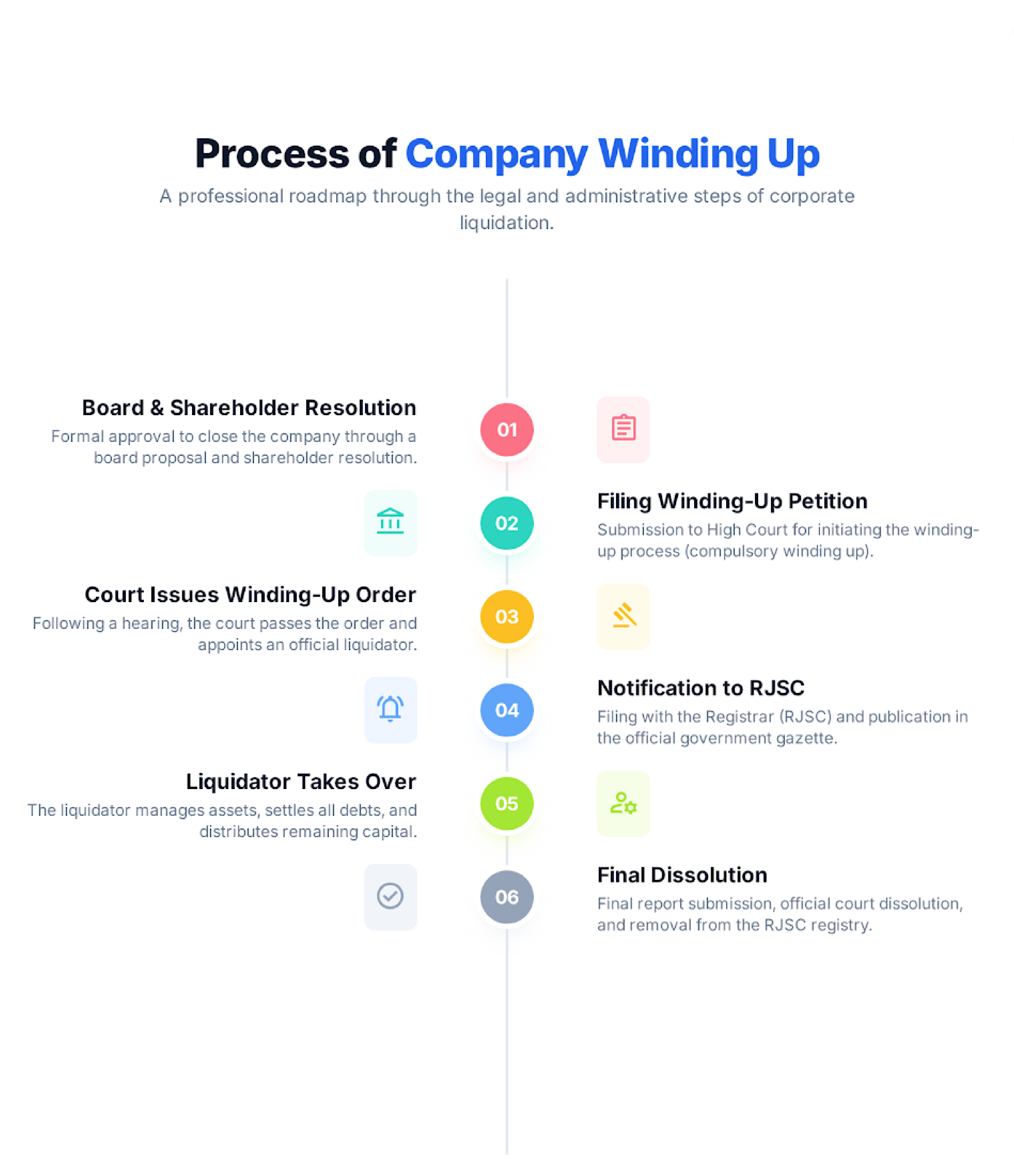
Step 1: Filing Petition
A petition must be filed with the Company Court in the High Court Division. The winding up process is deemed to commence at the time of petition presentation. The Court issues an order after hearing the application.
7
Step 2: Notification to Registrar
The petitioner and company must file a copy of the winding-up order with the RJSC within 30 days. The Registrar records this in company books and notifies the Official Gazette. This order acts as a discharge notice to employees.
8
Step 3: Appointment of Liquidator
The Court appoints an Official Liquidator to conduct duties per the Companies Act. From the date of the order, all company assets are deemed to be in the Court's custody.
9
Step 4: Final Dissolution
When affairs are fully wound up, the Court issues a dissolution order. The Liquidator must notify the Registrar within 15 days, who then enters a minute of dissolution in the books.
10
Voluntary Winding Up
A company may wind up voluntarily if:
• The duration expires or a dissolution event occurs (with general meeting resolution).
• The company passes a special resolution to wind up voluntarily.
• The company passes an extraordinary resolution that it cannot continue due to liabilities.
The Court may order voluntary winding up to proceed under its supervision (Sections 316-321).
11
Legal Considerations
• Inability to Pay Debts (Section 242): Deemed if a creditor's demand remains unpaid for 3 weeks or execution of a decree returns unsatisfied.
• Stay of Suits (Section 250): No suit shall be pursued without Court permission after a winding-up order.
• Insolvency: Assignees represent insolvent contributors (Sections 239-240).
12
Service Documentation
• Form DS01: Completion and submission of form DS01 along with requisite fees to the Registrar is required to start the process.
• Board Minutes: Legal experts draft minutes confirming the vote to dissolve.
13
FAQ: Stakeholder Notification
Who needs to be informed? Shareholders, creditors, banks, employees, suppliers, RJSC, and NBR must be notified to ensure proper closure and settlement of liabilities.
14
FAQ: Cancellation & Tax
Can I cancel? Yes, voluntary winding-up can be withdrawn before the final order via resolution and RJSC notification.
Tax Considerations: All dues (VAT, Income Tax) must be cleared. Remaining assets are distributed to shareholders only after settling liabilities.
15
FAQ: Timeline & Support
How long does it take? Voluntary winding-up typically takes 4 to 6 months. Court-led processes vary based on proceedings.
Support: Assistance is provided for document preparation, RJSC submission, public notices, tax clearance, and final closure.
gavel
Note: Winding up is a critical legal procedure governed by the Companies Act 1994. Professional legal counsel is strongly advised to navigate Court and RJSC requirements effectively.
Want us to handle this for you?
We follow these procedures every week. Tell us about your business and we’ll give you a fixed quote.